
In 2016 I decided I wanted to do something positive about climate change. It turns out that the top two pathways to a low carbon economy are greening the electric grid and the electrification of transportation.
I looked around my employer’s activities and nothing was available in this space. So, I quit and started working for a solar installer in the Saskatoon, SK area selling ground mount and roof mount solar arrays. I have a technical background so was able to grasp the fundamentals of this technology readily and to lay out arrays on rooves and ground spaces using CAD tools and Google Earth.
This led to working with a larger solar installer and eventually to taking a role with University of Saskatchewan as Manager, Facilities Sustainability and Engineering. Following this, I took a sales position with LightLeaf Solar, a manufacturer of lightweight, high performance solar modules manufactured in Saskatoon.
I then saw an opportunity to import used electric vehicles from United States and to sell them in Saskatchewan. The dealership operated for a year but I did not sell enough cars for the business to be viable and so I closed it down.
By this time, I had learned enough about renewable energy production and electric vehicles to approach my old employer about working for them in these areas. From 2022 to 2024 I led projects for their clients in various levels of development of solar, wind, and battery energy storage systems at the utility scale. In late 2024 I retired from full-time work.
I have driven an electric vehicle since 2017, and I love it. These vehicles are economical, quiet, powerful, and substantially reduce pollution to the environment. But although I had been advocating for people to install solar on their homes for several years, I hadn’t done so on my own. Finally in 2023, we installed 7.7 kWdc on the south wall of our house in Saskatoon.
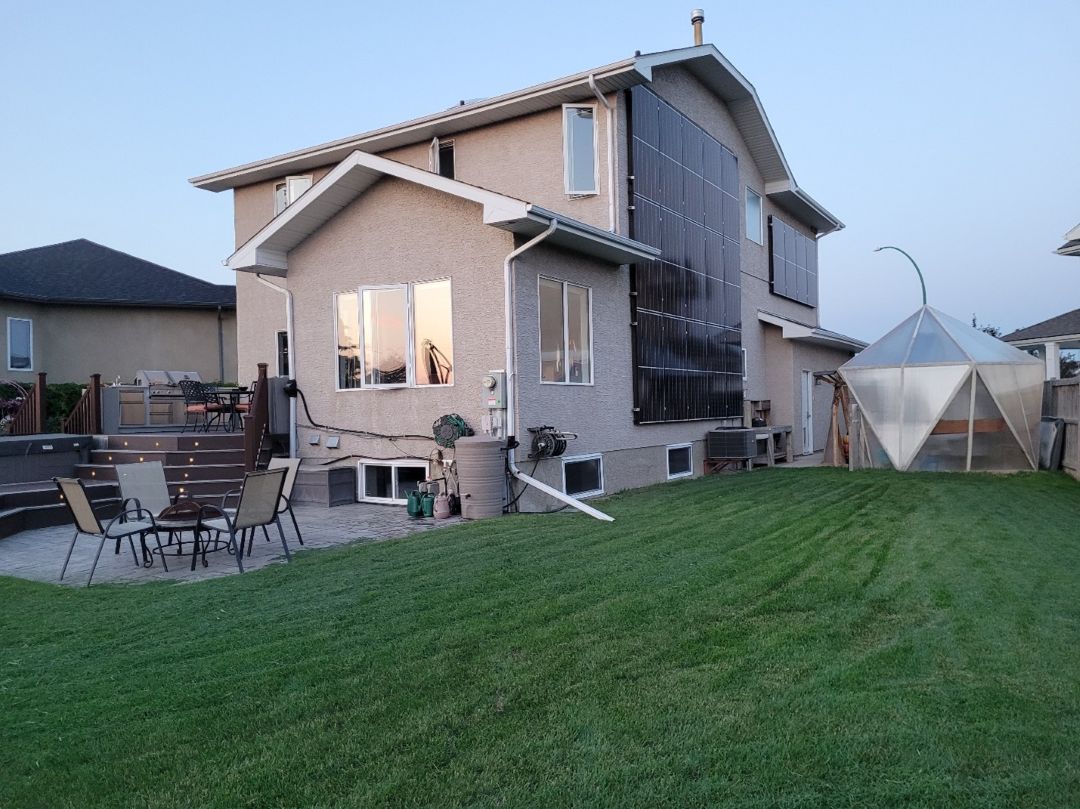
In the calendar year 2024, we produced 65% of our annual electricity consumption with our solar array. And that is with two electric vehicles in the household, mostly charging at home. We are connected to Saskatoon Light & Power’s distribution system and participate in their net metering program. There is minor shading from the neighbour’s house to the southeast in the winter months, but we expect that this results in an annual production penalty in the single digits percent. The south-facing, vertical array should produce about 79% of the production that would be seen from a south-facing array at 45 degrees.
The day with the highest solar production occurs in March. This is due to the competing factors of angle of incidence, day length, temperature, and cloudiness. Our household uses more energy in the cold months than in the warm months, so this contributes somewhat to matching our production to our consumption. In summer, the array also provides a shield against the direct radiant heating of the south wall of our house, reducing our air conditioning requirements.
We are very pleased with our installation. It looks beautiful. Drivers can see it driving along the road behind our house. You can see it when walking down the street toward the front of our house. As a solar power billboard, it doesn’t get much better than this.