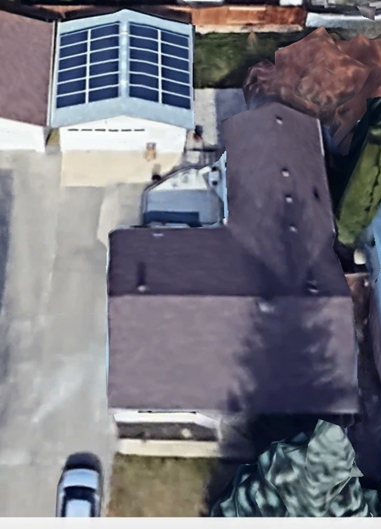
In 2020, we installed 24 x 370 w solar panels (8880 w total) on the garage roof, half facing east and half facing west. Four extra panels were required to account for not being able to face the panels optimally to the south. The total cost was $20,290 less the $5,470 provincial grant or $14,820. Go Solar Sask. completed the install as part of the 2020 Wascana Solar Co-op Group Buy initiative.
The system was sized to provide all the electricity required to operate our 1500 ft2 house (6300 KWh estimate) plus an eventual electric car (2300 KWh estimate), totalling 8600 kWh, on an annual basis. We were fortunate to be part of SaskPower’s original net-metering program.
Annual generation between 2020-2024 (5 years) for our system ranged between 7053-8254 KWh, averaging 7522 KWh per year. There is zero generation from December to February due to snow covering the panels. Most of the generation occurs in April through October. Because we did not yet own an electric car, and were producing more electricity than we used, in 2022, after three years of generation, our credit of 9620 kWh (worth about $1400) was cancelled by SaskPower, as per our agreement.
Based on historical power bills, we estimate that we are now saving about $900/yr for electricity for the house. We purchased a used 2022 Kona electric car in March 2023 and drove about 14,000 km over the past year. As most of our travel with the EV is within 100 km of Regina the Level 1 charger is sufficient. NRCan data suggests that a 2022 Kona with a gas engine uses about 8.0 l/100 km, so we avoided the purchase of about 1120 litres of gasoline to travel the same distance. Priced at $1.50 per litre this is equivalent to about $1680 in savings. Combined with not purchasing electricity for the house at $900/yr plus gasoline not purchased for the electric car at $1680, our total savings is about $2580 per year. And we have a surplus of approximately 1300 kWh to carry forward, which speaks to the array being oversized. At this rate, and without the grant, this system should pay for itself in roughly 8 years ($20,290/$2,580). Unfortunately, the current SaskPower power purchase plan is less supportive.
In 2023, SaskPower recorded their CO2e intensity as 511 t/GWh or 0.511 kg/KWh for all generation. Based on our average generation of 7522 KWh/year, the CO2e emissions avoided is about 3840 kg. Assuming that combusting one litre of gasoline produces 2.3 kg of CO2e, not combusting 1120 litres of gasoline further avoids the emission of 2576 kg of CO2e. Combined, our system indirectly avoids the emission of roughly 6.3 t of CO2e/year.
If I were to do this again, I would also conder installing more panels and an electric heater in the natural gas furnace plenum. Our high-efficiency furnace has a 2-speed DC motor which can operate continuously at a low speed, increasing when the demand calls. A regulated coil heater in the plenum could provide heating at the low furnace speed thereby replacing a portion of the gas demand.
This is a Google maps image of our east-west facing garage in Regina.